
Music’s a big part of my life. I go to gigs and listen to music on a very regular basis and recognise that it’s an important part of lots of people’s lives. And I think what’s really interesting is how that changes as you go through life.
I can’t remember what originally introduced me to Playlist for Life training. I think I’d seen a teaching session about it, and we got a trainer in several years ago to do hands-on training with some of the hospice staff. We rolled it out and used playlists on an ad-hoc basis on the ward in the first instance. Then we studied how we were using Playlist for Life, seeing how well it went and checking it was feasible to use it in a hospice inpatient setting. We got loads of positive feedback from patients, relatives and staff. But then our staffing changed and some of the staff who were key in using Playlist for Life moved on, and then Covid-19 came along and everything suddenly became more complicated to do. More recently though, we’ve had a music therapist at the hospice who very much recognised the importance of music which reignited my interest. We got in touch with Playlist for life again about rolling it out in a more comprehensive and sustainable manner. We want our organisation as a whole to become more fluent in using playlists in care, so that’s what we’re currently working towards.

We care for people at end-of-life, whether it be in their final weeks, months or longer and people who are facing a life limiting and progressive condition and there’s lots of ways that a playlist is helpful. From the clinician side of things, it helps us understand the patient better in terms of what is a comfort to them, what is important to them and that doesn’t necessarily always just mean the music, because the music can help facilitate conversations into lots of other areas of their life. I can think about people who are parents and the songs that they remember listening to with their children. There was one man who had The Lion King soundtrack and the reason for this was that he was dropping his 14-year-old off and he wanted to embarrass them so he would roll down the window and play ‘The Lion Sleeps Tonight’ at top volume and that was a nice way for me to see how music has impacted people’s lives in different ways.
From the patient’s perspective, they’re getting to express themselves as a person, but also because of the way we use it in palliative care, we’re able to go back through their life and reflect on things in a helpful way which can stimulate conversation and memory making. It helps families and friends to reminisce in conversations which is helpful during what can be quite challenging situations, and it also gives people legacy. At the hospice we put together physical things to go along with the playlist be that an MP3 player, a book, photos or tickets and other things that hold memories. This then gives the patient and their family something that they can take forward. Also, sometimes being in the hospice can be a bit boring and you can go over the same things, so this helps us have different things to talk about as a distraction and that can be a really important part of it as well.
I think it’s a useful tool to have in your bag if you’re dealing with life-limiting, progressive conditions. From a palliative care side of things, we’re trying to utilise it in a few different arms of our service, so while the inpatient unit is where I’m based and certainly where the focus has always been, we’re training up the wider hospice team now so that it can be used in other settings like outpatient and day hospice care living. Even some staff at the training who were a little more sceptical about the intervention have really leaned into it and find the value in that in terms of something that they have, so the staff have found it beneficial as well as the patients and the families.
Again, we’re a healthcare organisation, but it doesn’t have to be doctors or nurses who are involved. You can train up befrienders and volunteers as well to be involved in this process and it can be really helpful in lots and lots of different ways.
One that I often talk about is a lovely man who was in the hospice for a while, but he stabilised and did really well. He was an Italian gentleman who’d had a long and colourful life and he’d put together, with one of our healthcare assistants, his ‘playlist for life’. They also created a book, and it had things like the song from his first dance at his wedding and there was a photo with that. And there’d been songs from when they’d had their children and then photos from more recent memories. It was a beautiful storybook of his life connected to music and he was able to go home for a while but he became unwell again and was admitted to hospital. I saw him in the ward when he was very close to end of life. I remember him being in his hospital room which was really clinical but by his bed was his Playlist for Life book that had created and he was hugely proud of it. The music from his playlist was playing in his hospital room so it wasn’t just about having the playlist in the hospice or having it at end-of-life care. It was something he had the opportunity to make and explain and connect with and be proud of.
Playlists can help because not everyone feels confident or comfortable with a pen-and-paper art activity. A lot of people feel a strong connection with music, even if they don’t play an instrument or sing, it can be an inclusive activity for different groups of patients. In palliative care we’re quite used to thinking about complementary therapies and psychosocial support and spiritual care so music ties in nicely with that.
Spiritual care is a lot about understanding someone’s sense of identity and their sense of purpose in the world. That can commonly hang with a religious framework, and we certainly work with lots of people who have a strong faith and spirituality is connected to that. But we also care for people who don’t have a faith but might struggle with spiritual questions about what life is and what happens when facing a life-limiting and progressing condition. And music may seem like something really superficial in some ways, but actually it brings out connections with your loved ones and with your emotions in a different way.
No downsides. Lots of potential upsides. Would recommend.
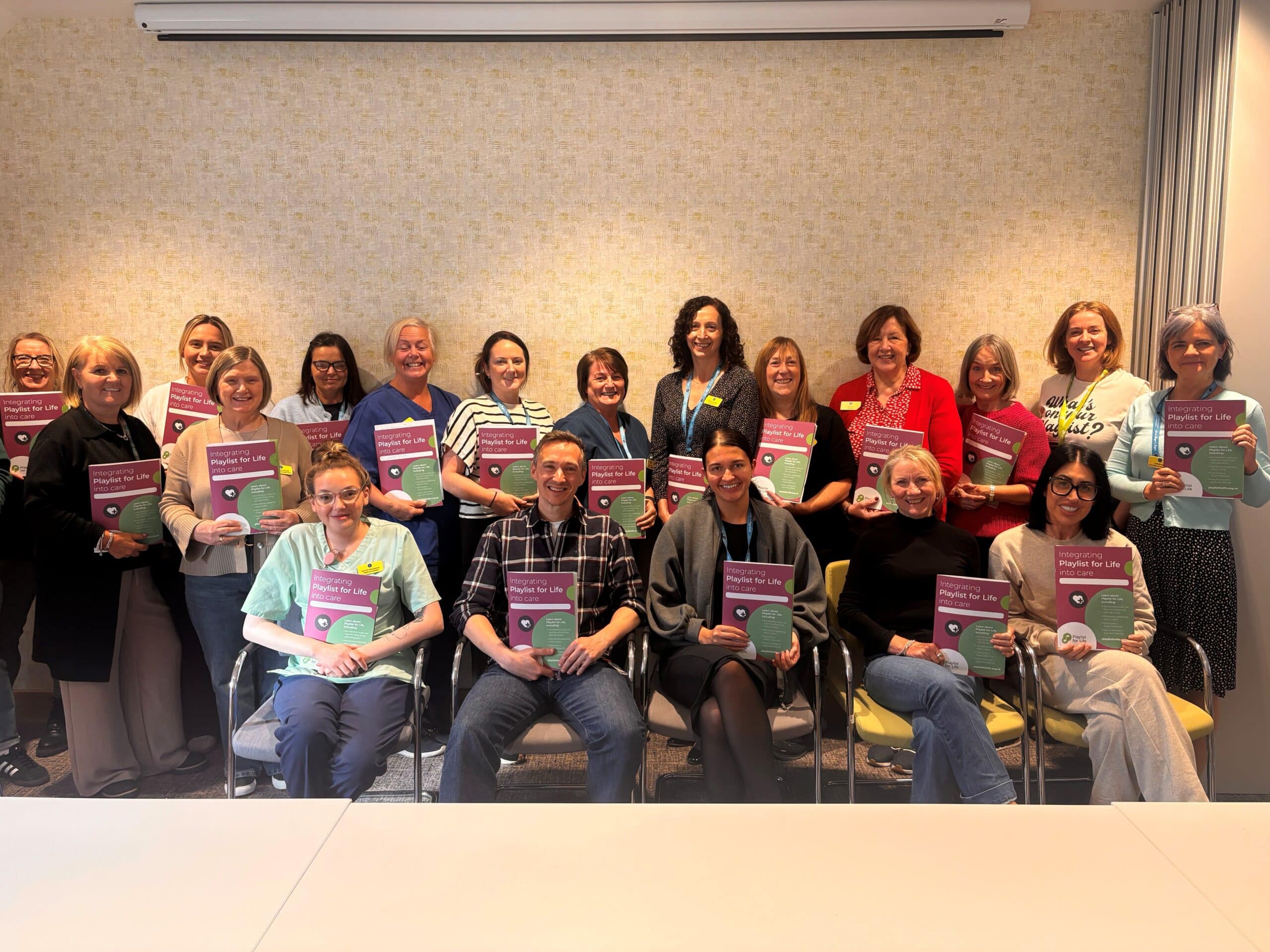
Dr. McKeown and his colleagues at the hospice completed Playlist for Life’s Embedding Personal Playlists into Care course.
This tailor-made ‘Certified’ course has been developed alongside practitioners to support health and social care teams to integrate Playlist for Life into existing care networks helping to showcase to residents, families and regulators, a commitment to providing excellent person-centred care.
We also offer introductory sessions as well as courses tailored for professionals and students.